






Proposition 28 - General Information
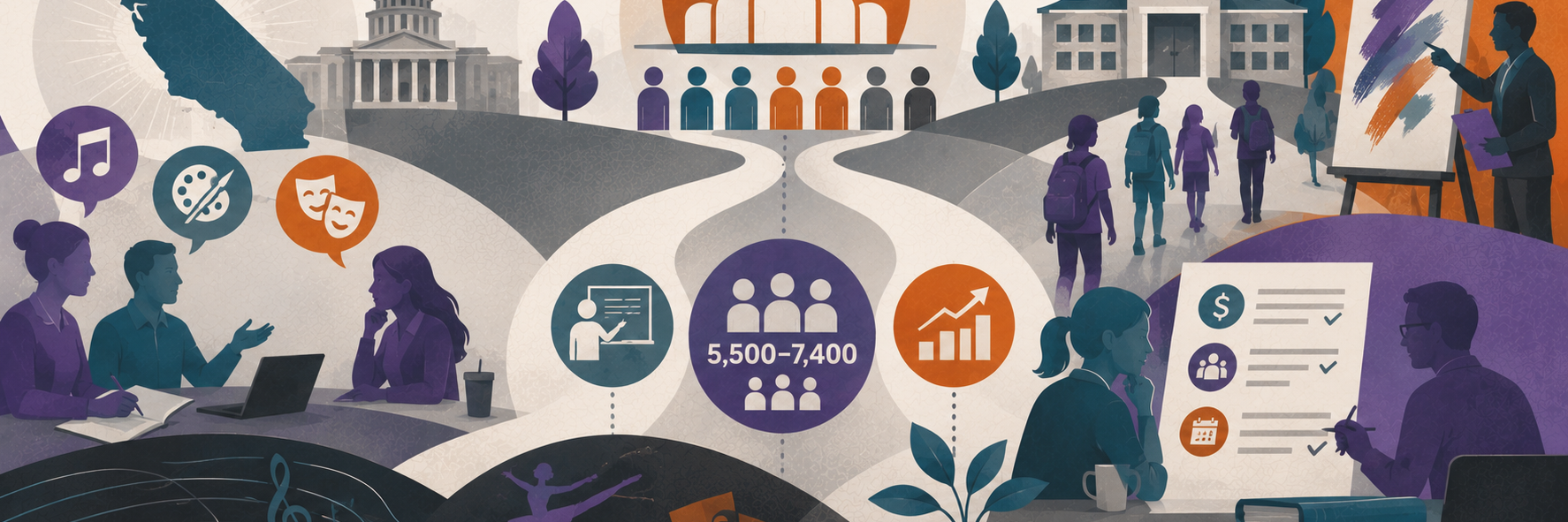
An overview of California’s Proposition 28, including its purpose, funding structure, and potential impact on visual and performing arts education across the state.

Proposition 28 and Visual and Performing Arts Workforce: Reports Crosswalk
As California schools expand arts education opportunities through Proposition 28, institutions across the state are simultaneously exploring how to recruit, prepare, and sustain a qualified visual and performing arts educator workforce. Numerous reports, policy briefs, and strategic recommendations have emerged in response to these challenges, often approaching the issue from different perspectives. This crosswalk resource brings those conversations together by identifying areas of overlap, recurring themes, and shared recommendations across workforce development discussions related to arts education. Topics include educator preparation pathways, residency and apprenticeship models, credentialing, mentorship, community partnerships, and long-term sustainability. By organizing and connecting these reports in a single view, this resource is intended to help educators, policymakers, higher education leaders, and arts organizations better navigate the broader landscape surrounding Proposition 28 implementation and workforce development planning.
Key Takeaways
- Multiple statewide reports identify growing demand for qualified arts educators
- Workforce development conversations consistently emphasize mentorship and clinical practice
- Residency and apprenticeship pathways appear across many strategic recommendations
- Cross-sector partnerships are central to sustainable arts education expansion
- Proposition 28 implementation requires both funding and long-term educator pipeline development
Proposition 28 & Arts Education
Resources to help educators, school leaders, and partners understand Proposition 28, strengthen arts education, and prepare the next generation of arts educators.



All VAPA and Prop 28 Resources
| Thumbnail | |||
|---|---|---|---|
 Proposition 28: How Teacher Residencies Can Foster High-Quality Arts Educators (opens in new tab)
|
Proposition 28: How Teacher Residencies Can Foster High-Quality Arts Educators
(opens in new tab)
As California expands investment in arts education through Proposition 28, teacher residency programs offer a promising model for preparing and supporting the next generation of visual and performing arts educators. |
Research | March 2026 |
 Proposition 28 and the Future of Arts Education in California (opens in new tab)
|
Proposition 28 and the Future of Arts Education in California
(opens in new tab)
An exploration of how Proposition 28 creates an unprecedented opportunity to expand arts education, strengthen educator preparation, and build sustainable pathways for the next generation of California arts educators. |
Research | March 2026 |
 Proposition 28 and Visual and Performing Arts Workforce: Reports Crosswalk (opens in new tab)
|
Proposition 28 and Visual and Performing Arts Workforce: Reports Crosswalk
(opens in new tab)
A crosswalk connecting major reports, recommendations, and workforce development conversations related to Proposition 28 and the future of visual and performing arts education in California. |
Framework | February 2026 |
 Growing Visual and Performing Arts Teacher Credentialing Programs (opens in new tab)
|
Growing Visual and Performing Arts Teacher Credentialing Programs
(opens in new tab)
An exploration of strategies and emerging pathways designed to expand and strengthen visual and performing arts teacher credentialing programs in California. |
Workforce | February 2026 |
 Proposition 28 - What Educators and Administrators Need to Know (opens in new tab)
|
Proposition 28 - What Educators and Administrators Need to Know
(opens in new tab)
A practical overview of key considerations for educators and administrators implementing Proposition 28-funded visual and performing arts programs. |
Toolkit | February 2026 |
 Proposition 28 - General Information (opens in new tab)
|
Proposition 28 - General Information
(opens in new tab)
An overview of California’s Proposition 28, including its purpose, funding structure, and potential impact on visual and performing arts education across the state. |
Guide | February 2026 |
 Art for Life's Sake: The Case for Arts Education (opens in new tab)
|
Art for Life's Sake: The Case for Arts Education
(opens in new tab)
This is a report from the American Academy of Arts and Sciences. he arts are facing a grave threat as this report goes to press. As the report shows, arts education was sorely underresourced even before the pandemic arrived, and that was before educators had to deliver their work through computer screens—a poor substitute for the group and student-teacher dynamics that are so essential to an arts education. And as we look to the future, the devastating financial effects from the pandemic threaten the local and state funding streams that underwrite classes in the subject. The Commission on the Arts was established in the fall of 2018 to address the first issue, but the events of the past year underscore the precarious nature of arts education in our nation’s schools. This report offers a clarion call to parents, teachers, and governments at the national, state, and local level to recognize the vital role arts education plays in developing empathetic, well-rounded, and civically engaged individuals who are prepared to be active members of their communities and participants in our democracy. |
Resource | March 2026 |
 CA County Superintendents Arts Initiative Teaching and Learning Resources (opens in new tab)
|
CA County Superintendents Arts Initiative Teaching and Learning Resources
(opens in new tab)
The California Arts Standards for Public Schools, Prekindergarten Through Grade Twelve were adopted by the State Board of Education on January 9, 2019. The 2019 arts standards provide the foundation for teaching and learning in the arts in California. |
Resource | March 2026 |
 California Commission on Teacher Credentialing: Roadmap to Teaching (opens in new tab)
|
California Commission on Teacher Credentialing: Roadmap to Teaching
(opens in new tab)
There have never been more opportunities than there are now to become an educator in California. What are you waiting for? To make this process as easy as possible, you can find links to everything you need to know about becoming an educator on this page. The roadmap below shows each step of becoming a teacher here in California. Take a look to see how to get started on your road to a career in education! |
Resource | March 2026 |
 Commentary: California must invest in professional learning for arts teachers (opens in new tab)
|
Commentary: California must invest in professional learning for arts teachers
(opens in new tab)
California voters demonstrated their commitment to arts education in our schools with the passage of Proposition 28, which brings unprecedented resources for teaching the arts to every school in California. The state also adopted a forward-looking arts standards and curriculum framework and reinstated theater and dance credentials. Read this EdSource Blog to learn more about VAPA Education. |
Resource | March 2026 |
 Completing the Multiple Subject SMC Coursework Evaluation Matrix (opens in new tab)
|
Completing the Multiple Subject SMC Coursework Evaluation Matrix
(opens in new tab)
The Completing the Multiple Subject SMC Coursework Evaluation Matrix is a guide for teacher credential candidates to prove Subject Matter Competency by documenting their college courses. It requires candidates to provide exact course details and catalog links, ensuring all submitted, degree-applicable coursework covers the nine required content areas and has a passing grade of "C" or higher. |
Resource | February 2026 |
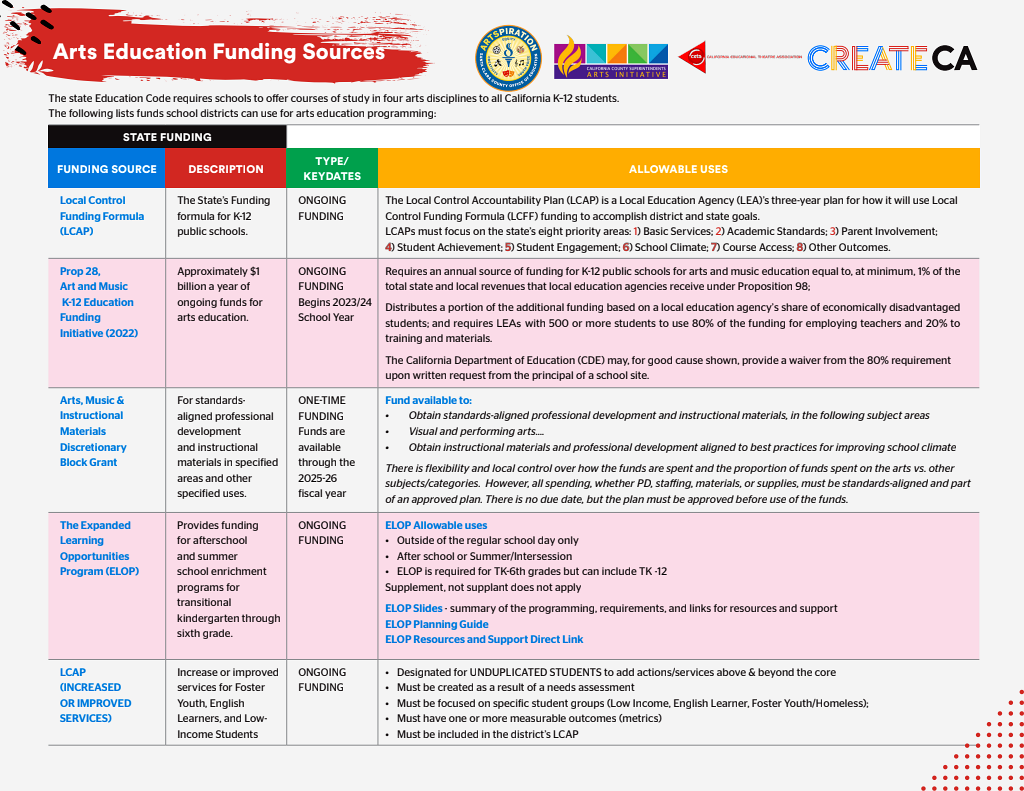 Create CA: Arts Education Funding Sources (opens in new tab)
|
Create CA: Arts Education Funding Sources
(opens in new tab)
The state Education Code requires schools to offer courses of study in four arts disciplines to all California K–12 students. This resource lists funds school districts can use for arts education programming. |
Resource | March 2026 |
 Create CA: Prop 28: What We Know (So Far) – UPDATED JUNE 2025 (opens in new tab)
|
Create CA: Prop 28: What We Know (So Far) – UPDATED JUNE 2025
(opens in new tab)
In November 2022, nearly 7 million California voters overwhelmingly approved Proposition 28: The Arts and Music in Schools — Funding Guarantee and Accountability Act. We know you’ve got questions about Prop 28 implementation, and so do we! In the spirit of transparency and partnership, here’s what Create CA knows, what we don’t know, and what you can do. |
Resource | March 2026 |
 Create CA: Strategic Arts Education Planning (opens in new tab)
|
Create CA: Strategic Arts Education Planning
(opens in new tab)
To deliver high-quality, culturally-relevant arts education courses to students, school districts and county offices of education need a Strategic Arts Education Plan in place. Create CA is here to help support the creation of arts education strategic plans! |
Resource | March 2026 |
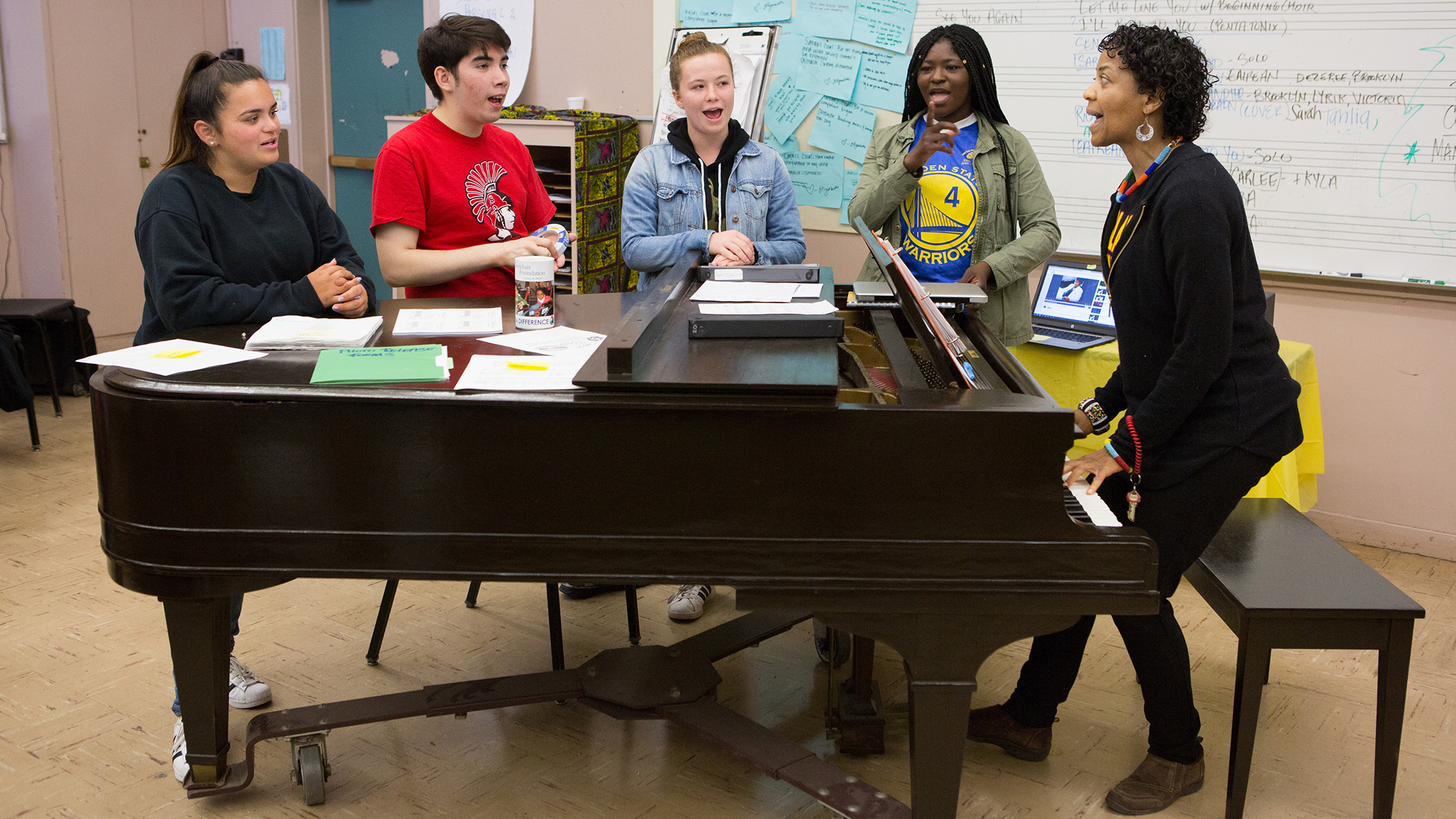 Creative license: Strengthening teaching and learning in the visual and performing arts (opens in new tab)
|
Creative license: Strengthening teaching and learning in the visual and performing arts
(opens in new tab)
This blog post by the Hewlett Foundation highlights the importance of artistic freedom and expression, a value that underpins the Hewlett Foundation’s commitment to arts education as essential to whole-child development and community well-being. While the 2022 Arts and Music in Schools (AMS) Act represents a historic investment—allocating nearly $1 billion to expand arts access across California—significant inequities remain due to longstanding shortages of credentialed arts educators. A new analysis by SRI Education estimates that California will need approximately 5,457 additional arts teachers statewide, underscoring both the promise of the AMS Act and the urgent need to strengthen the arts educator workforce to fully realize its impact. |
Resource | March 2026 |
 Edsource: Does California need teacher residencies for arts educators? (opens in new tab)
|
Edsource: Does California need teacher residencies for arts educators?
(opens in new tab)
In response to California’s long-standing teacher shortage, the state has been investing in recruitment efforts such as internships, apprenticeships and residencies, all designed to attract new teachers to the profession. Now, in light of the thousands of jobs being generated by Proposition 28, many arts education advocates are aspiring to lean into the same strategies, looking to create more alternate pathways into arts education at the TK-12 level. |
Resource | March 2026 |
 General VAPA Resources (opens in new tab)
|
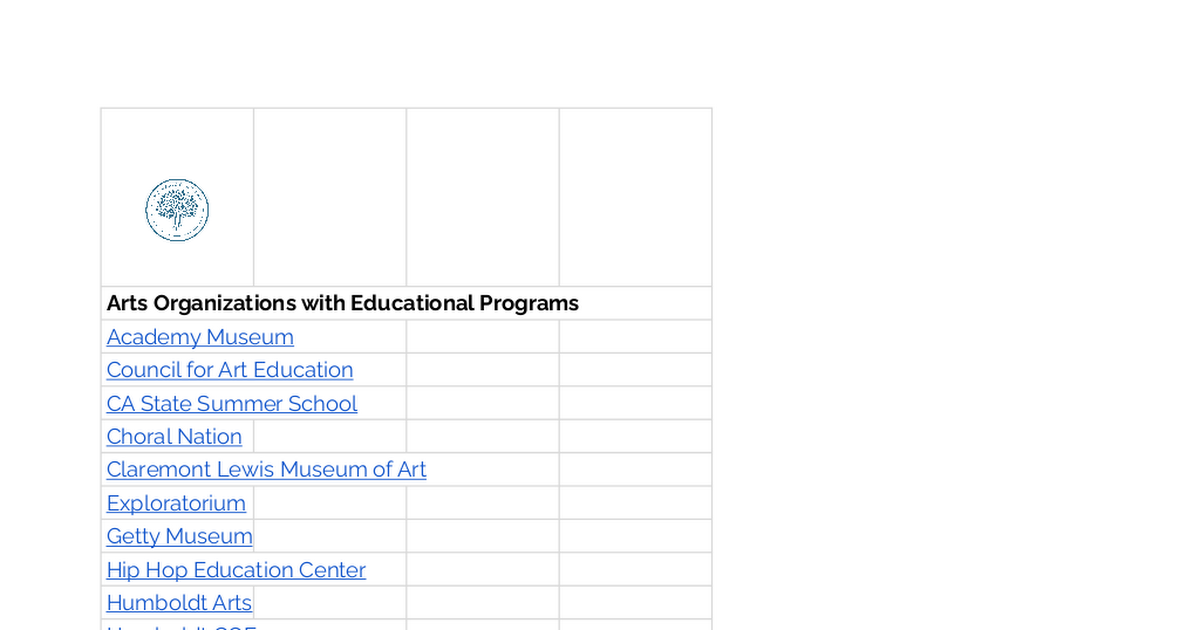
General VAPA Resources
(opens in new tab)
This sheet links to several Arts Organizations with Educational Programming, Arts Advocacy organizations, and Arts Education Resources. |
Resource | March 2026 |
 Inspiring Creative Collaborations between Arts and STEM Residencies: The National Geographic Slingshot Challenge (opens in new tab)
|
Inspiring Creative Collaborations between Arts and STEM Residencies: The National Geographic Slingshot Challenge
(opens in new tab)
Research shows that integrating the arts into STEM education enhances student achievement, deepens cognitive development, and strengthens educator effectiveness, though it requires intentional planning and collaboration. The Residency Lab is supporting this work by partnering with Dr. Brittney Beck to connect STEM and VAPA residency programs through the National Geographic Slingshot Challenge, which engages students in interdisciplinary, real-world problem solving. The challenge invites students to create short videos proposing solutions to environmental issues, blending science, civic engagement, and artistic storytelling to amplify youth voice and innovation. This approach provides a powerful, cross-curricular opportunity for students to apply their learning, develop communication skills, and take meaningful action on issues impacting their communities. |
Resource | March 2026 |
 LPI: Building a Strong and Diverse Teaching Profession (opens in new tab)
|
LPI: Building a Strong and Diverse Teaching Profession
(opens in new tab)
The Teaching Profession Playbook from the Partnership for the Future of Learning offers a comprehensive set of strategies that work together to recruit, prepare, develop, and retain high-quality teachers and bring greater racial, ethnic, and linguistic diversity to the profession. Read it cover to cover or explore a single chapter, depending on your local or state circumstances. Additional resources include examples of legislation and research-based policies; a curated list of publications, by topic, for further reading; and a guide to talking about teacher shortages and strengthening the profession. |
Resource | March 2026 |
 LPI: The Instructional Leadership Corps: Entrusting Professional Learning in the Hands of the Profession (opens in new tab)
|
LPI: The Instructional Leadership Corps: Entrusting Professional Learning in the Hands of the Profession
(opens in new tab)
The Instructional Leadership Corps (ILC) is an innovative professional learning project in which teacher leaders in California collaborate to lead sustainable professional development to support implementation of new student standards within their districts. Over more than 4 years, the ILC has served over 100,000 teachers. The responses of these educators to ILC conferences and trainings have been overwhelmingly positive. This brief describes how the ILC has changed the professional development landscape in four communities, offering lessons about how teacher-led learning can motivate shifts in practice, enhance teachers’ professionalism and efficacy, and create supportive systems and strategic relationships that can sustain change. |
Resource | March 2026 |
 SRI: The State of Arts Education in California (opens in new tab)
|
SRI: The State of Arts Education in California
(opens in new tab)
California has long maintained ambitious goals for arts education. The state Education Code requires schools to offer courses of study in four arts disciplines to all California K–12 students.1 In 2005/06, with support from the William and Flora Hewlett Foundation, SRI Education researchers conducted a study of arts education in California. Our goal was to assess schools’ arts programs relative to state goals, examine the systems of support for these programs, and identify ways in which state and local policymakers might improve conditions for young people to experience arts education in schools. In 2019, the Hewlett Foundation engaged SRI to “refresh” the 2007 study. In most ways, the current study addresses the same research questions and relies on the same research design and data sources as the earlier report—a statewide school survey, case studies, and analysis of extant data provided by the California Department of Education. The context, however, has changed. Perhaps most prominently, in 2013, with the Local Control Funding Formula (LCFF), California radically changed its system for funding schools. Importantly, we examined arts education in California schools in school year 2019/20 and as such the data collected for this study reflect the status of arts education in California prior to the pandemic. In 2021 and 2022, before the release of this report (but after data collection), California enacted a host of new policies that may improve students’ opportunities to experience arts education in schools. Overall, we found that, while much remained the same in 2020 as in 2006, some aspects of arts education in California’s K–12 schools had improved. These improvements coincide with funding increases associated with LCFF and career and technical education (CTE), coordinated advocacy efforts, changes to the state accountability system, and substantial increases in support from school districts, counties, and partner organizations. Nonetheless, despite improvements, California schools still fall short of state goals for arts education and a persistent pattern of inequity emerges from our current data. |
Resource | March 2026 |
 Subject Matter Competency (SMC) Coursework Evaluation Template for Multiple Subject Credentials (opens in new tab)
|
Subject Matter Competency (SMC) Coursework Evaluation Template for Multiple Subject Credentials
(opens in new tab)
The Subject Matter Competency Coursework Evaluation Template for Multiple Subject Credentials provides a formal option for candidates to demonstrate competency by submitting college coursework that covers the nine mandated content areas outlined in Education Code 44282. This resource guides the candidate to document specific courses, grades (must be "C" or higher), and corresponding course catalogs from the exact semester they were taken, while adhering to the legislative requirements that the coursework be degree-applicable, credit-bearing, and non-remedial. |
Resource | February 2026 |
 Teach California: My Career Plan — a California Teaching Requirement Tool (opens in new tab)
|
Teach California: My Career Plan — a California Teaching Requirement Tool
(opens in new tab)
My Career Plan — a California Teaching Requirement Tool Confused by all the different California teaching requirements? We can make it simple with My Career Plan — A checklist tool based on your unique responses to questions. Make and follow your plan. |
Resource | March 2026 |
 The California Arts Project (opens in new tab)
|
The California Arts Project
(opens in new tab)
The California Arts Project (TCAP) is a collaborative statewide network of teachers and university scholars with the singular goal of expanding student access to and improving student artistic literacy development in dance, media arts, music, theatre, visual, and career arts. |
Resource | March 2026 |
 The Qualities of Quality: Understanding Excellence in Arts Education (opens in new tab)
|
The Qualities of Quality: Understanding Excellence in Arts Education
(opens in new tab)
Many children in the United States have little or no opportunity for formal arts instruction, and access to arts learning experiences remains a critical national challenge. In addition, the quality of arts learning opportunities that are available to young people is a serious concern. Understanding this second challenge – the challenge of creating and sustaining high quality formal arts learning experiences for K-12 youth, inside and outside of school – is the focus of our recent research initiative, The Qualities of Quality: Understanding Excellence in Arts Education, commissioned by The Wallace Foundation and conducted by Project Zero at the Harvard Graduate School of Education. The study focuses on the character of excellence itself and asks three core questions: (1) How do arts educators in the United States – including leading practitioners, theorists, and administrators – conceive of and define high quality arts learning and teaching? (2) What markers of excellence do educators and administrators look for in the actual activities of arts learning and teaching as they unfold in the classroom? (3) How do a program’s foundational decisions, as well as its ongoing day-to-day decisions, affect the pursuit and achievement of quality? |
Resource | March 2026 |
 UChicago Report: Arts Education and Social-Emotional Learning Outcomes Among K-12 Students (opens in new tab)
|
UChicago Report: Arts Education and Social-Emotional Learning Outcomes Among K-12 Students
(opens in new tab)
Social and emotional learning is a topic of increasing focus in the education sector. Though definitions and terminology vary, at its core this trend reflects an increased interest among educators, administrators, parents, and other stakeholders in students’ development of individual and interpersonal skills beyond the realm of academic achievement. |
Resource | March 2026 |
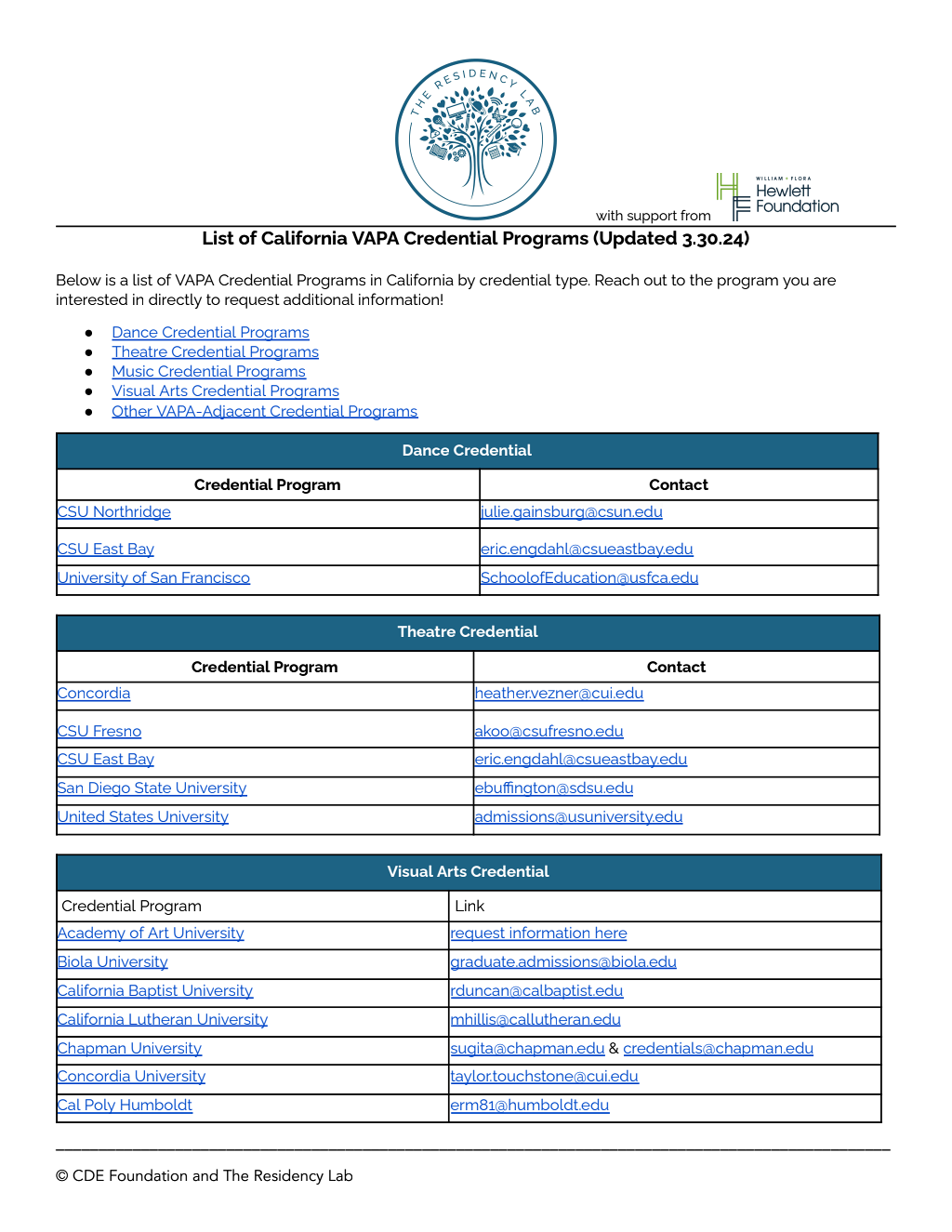 VAPA California Credential Programs (opens in new tab)
|
Resource | March 2026 | |
 What the California Arts and Music in Schools Act Means for the Arts Teacher Workforce (opens in new tab)
|
What the California Arts and Music in Schools Act Means for the Arts Teacher Workforce
(opens in new tab)
In November 2022, California established the Arts and Music in Schools Act to fund arts education programs in TK–12 public schools. With funding from the William and Flora Hewlett Foundation, SRI Education led an inquiry to estimate the number of new arts teachers required to fulfill the promise of the act. This brief presents funding allocations and teacher costs to calculate new teachers needed by region and county. It also provides information on the current state of the arts teacher workforce and arts teacher credentialing programs. |
Resource | March 2026 |